
Free Download
(TORRENT)
Showing posts with label Qawwali. Show all posts
Showing posts with label Qawwali. Show all posts
Wednesday, June 11, 2008
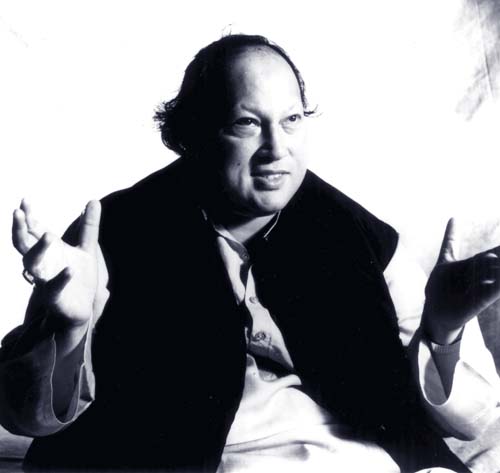

Nusrat Fateh Ali Khan
Ustad Nusrat Fateh Ali Khan (October 13, 1948 - August 16, 1997) was primarily a singer of Qawwali, the devotional music of the Sufis, a mystical offshoot of Islam. Traditionally, Qawwali has been a family business. Nusrat’s family (originally from Afghanistan, though been living all their life in Pakistan) has an unbroken tradition of performing qawwali for the last 600 years.
Nusrat took over his family’s qawwali party in 1971 after the death of his father and his uncle. In Pakistan, his first major hit was the song “Haq Ali Ali”. This was performed in a traditional style and with traditional instrumentation, and featured only sparse use of Nusrat’s innovative sargam improvisations. Nevertheless the song became a major hit, as many listeners were attracted to the timbre and other qualities of Nusrat’s voice.
He reached out to Western audiences with a couple of fusion records produced by Canadian guitarist Michael Brook. In 1995, he collaborated with Eddie Vedder on the soundtrack to Dead Man Walking. His contribution to that and several other soundtracks and albums (including The Last Temptation of Christ), as well as his friendship with Peter Gabriel, helped to increase his popularity in Europe and the United States. Peter Gabriel’s Real World label released five albums of Nusrat’s traditional Qawwali performances in the West. He also performed traditional Qawwali live to Western audiences at several WOMAD world music festivals.
Nusrat was noted for introducing other forms of improvisation into the style. From his classical music training, he would interject much more complex alap improvisations, with more vibrato and note bending (listen here). He would also interject sargam improvisations.
While it is undoubtedly difficult to put into words what makes Nusrat’s music appeal so deeply to so many listeners, many of whom do not understand a single word of the languages he sings in, here is one fan’s attempt to explain: “Nusrat’s music invites us to eavesdrop on a man communing with his God, ever so eloquently. He makes the act of singing a passionate offering to God. But we do not merely eavesdrop. The deepest part of Nusrat’s magic lies in the fact that he is able to bring our hearts to resonate with the music, so deeply, that we ourselves become full partners in that offering. He sings to God, and by listening, we also sing to God.”
“Singing with Nusrat was pretty heavy,” says Eddie Vedder. “There was definitely a spiritual element. I saw him warm up once, and I walked out of the room and just broke down. I mean, God, what amazing power and energy.”
The late American rock singer Jeff Buckley paid tribute to Nusrat on the album “Live at Sin-é (Legacy Edition).” In his introduction, he states, “Nusrat, he’s my Elvis,” before performing the song “Yeh Jo Halka Halka Saroor Hai”. This recording generated interest in Nusrat among an audience that was previously unaware of his music.
In 2005, a tribute band called Brook’s Qawwali Party was formed in New York City by percussionist Brook Martinez to perform the music of Nusrat Fateh Ali Khan. The 11+ piece group performs (mostly instrumental) jazz versions of Nusrat’s traditional qawwali songs, using the instruments conventionally associated with jazz (saxophones, brass, electric guitar, double bass, djembe, drum set, and percussion) rather than those associated with qawwali.
Nusrat took over his family’s qawwali party in 1971 after the death of his father and his uncle. In Pakistan, his first major hit was the song “Haq Ali Ali”. This was performed in a traditional style and with traditional instrumentation, and featured only sparse use of Nusrat’s innovative sargam improvisations. Nevertheless the song became a major hit, as many listeners were attracted to the timbre and other qualities of Nusrat’s voice.
He reached out to Western audiences with a couple of fusion records produced by Canadian guitarist Michael Brook. In 1995, he collaborated with Eddie Vedder on the soundtrack to Dead Man Walking. His contribution to that and several other soundtracks and albums (including The Last Temptation of Christ), as well as his friendship with Peter Gabriel, helped to increase his popularity in Europe and the United States. Peter Gabriel’s Real World label released five albums of Nusrat’s traditional Qawwali performances in the West. He also performed traditional Qawwali live to Western audiences at several WOMAD world music festivals.
Nusrat was noted for introducing other forms of improvisation into the style. From his classical music training, he would interject much more complex alap improvisations, with more vibrato and note bending (listen here). He would also interject sargam improvisations.
While it is undoubtedly difficult to put into words what makes Nusrat’s music appeal so deeply to so many listeners, many of whom do not understand a single word of the languages he sings in, here is one fan’s attempt to explain: “Nusrat’s music invites us to eavesdrop on a man communing with his God, ever so eloquently. He makes the act of singing a passionate offering to God. But we do not merely eavesdrop. The deepest part of Nusrat’s magic lies in the fact that he is able to bring our hearts to resonate with the music, so deeply, that we ourselves become full partners in that offering. He sings to God, and by listening, we also sing to God.”
“Singing with Nusrat was pretty heavy,” says Eddie Vedder. “There was definitely a spiritual element. I saw him warm up once, and I walked out of the room and just broke down. I mean, God, what amazing power and energy.”
The late American rock singer Jeff Buckley paid tribute to Nusrat on the album “Live at Sin-é (Legacy Edition).” In his introduction, he states, “Nusrat, he’s my Elvis,” before performing the song “Yeh Jo Halka Halka Saroor Hai”. This recording generated interest in Nusrat among an audience that was previously unaware of his music.
In 2005, a tribute band called Brook’s Qawwali Party was formed in New York City by percussionist Brook Martinez to perform the music of Nusrat Fateh Ali Khan. The 11+ piece group performs (mostly instrumental) jazz versions of Nusrat’s traditional qawwali songs, using the instruments conventionally associated with jazz (saxophones, brass, electric guitar, double bass, djembe, drum set, and percussion) rather than those associated with qawwali.
Tuesday, February 5, 2008
Qawwali
Qawwali is the devotional music of the Chishti Sufis of the Indian subcontinent. Qawwali is a vibrant musical tradition that stretches back more than 700 years. Originally performed mainly at Sufi shrines throughout the subcontinent, it has also gained mainstream popularity. Qawwali music received international exposure through the work of the late Nusrat Fateh Ali Khan, largely due to several releases on the Real World label, followed by live appearances at WOMAD festivals. Listeners, and often artists themselves are transported to a state of wajad, a trance-like state where they feel at one with God, generally considered to be the height of spiritual ecstasy in Sufism. Although famous throughout the world, its economic and spiritual hub remains Punjab province of Pakistan from where it gained entry into the main stream commercial music industry and international fame.

The roots of Qawwali can be traced back to 8th century Persia (today's Iran and Afghanistan). However, Qawwali in the form we know it today was essentially created by Amir Khusrau Dehelvi in the late 13th century in India.
During the first major migration from Persia, in the 11th century, the musical tradition of Sama migrated to the Indian subcontinent, Turkey and Uzbekistan. Rumi and his Mevlana order of Sufism have been the propagators of Sama in Central Asia. Amir Khusrau of the Chisti order of Sufis is credited with fusing the Persian and South Asian musical traditions, to create Qawwali as well as the Hindustani classical music tradition. The word "Sama" is used (or is the preferred name) in Central Asia and Turkey, for forms very similar to Qawwali. And even in India, Pakistan and Bangladesh, the formal name used for a session of Qawwali is "Mehfil-e-Sama".
Content:
The songs which constitute the qawwali repertoire are mostly in Urdu and Punjabi (almost equally divided between the two), though there are several songs in Persian, Brajbhasha and Siraiki. There is also qawwali in some regional languages (e.g., Chhote Babu Qawwal sings in Bengali), but the regional language tradition is relatively obscure. Also, the sound of the regional language qawwali can be totally different from that of mainstream qawwali. This is certainly true of Chhote Babu Qawwal, whose sound is much closer to Baul music than to the qawwali of Nusrat Fateh Ali Khan, for example.
The poetry is implicitly understood to be spiritual in its meaning, even though the lyrics can sometimes sound wildly secular, or outright hedonistic. The central themes of qawwali are love, devotion and longing (of man for the Divine).
Qawwalis are classified by their content into several categories:
- A hamd is a song in praise of Allah. Traditionally, a qawwali performance starts with a hamd.
- A naat is a song in praise of the Prophet Muhammad. The opening hamd is traditionally followed by a naat.
- A manqabat is a song in praise of either Imam Ali or one of the Sufi saints. Interestingly, manqabats in praise of Ali are sung at both Sunni and Shi'a gatherings. If one is sung, it will follow right after the naat. There is usually at least one manqabat in a traditional programme.
- A marsiya is a lamentation over the death of much of Imam Husayn's family in the Battle of Karbala. Once again, this would typically be sung only at a Shi'a concert.
- A ghazal is a song that sounds secular on the face of it. There are two extended metaphors that run through ghazals -- the joys of drinking and the agony of separation from the beloved. These songs feature exquisite poetry, and can certainly be taken at face value, and enjoyed at that level. In fact, in India and Pakistan, ghazal is also a separate, distinct musical genre in which many of the same songs are performed in a different musical style, and in a secular context. In the context of that genre, the songs are usually taken at face value, and no deeper meaning is necessarily implied. But in the context of qawwali, these songs of intoxication and yearning use secular metaphors to poignantly express the soul's longing for union with the Divine, and its joy in loving the Divine. In the songs of intoxication, "Wine" represents "knowledge of the Divine", the "Cupbearer" (saaqi) is God or a spiritual guide, the "Tavern" is the metaphorical place where the soul may (or may not) be fortunate enough to attain spiritual enlightenment. (The "Tavern" is emphatically not a conventional house of worship. Rather, it is taken to be the spiritual context within which the soul exists) Intoxication is attaining spiritual knowledge, or being filled with the joy of loving the Divine. In the songs of yearning, the soul, having been abandoned in this world by that cruel and cavalier lover, God, sings of the agony of separation, and the depth of its yearning for reunion.
- A kafi is a song in Punjabi, which is in the unique style of poets such as Shah Hussain and Baba Bulleh Shah. Two of the more popular Kafis include Ni Main Jana Jogi De Naal and Mera Piya Ghar Aaya.
- A munadjaat is a song where the singer displays his thanks to Allah through a variety of linguistic techniques. It is often sung in Persian, with Mawlana Jalāl-ad-Dīn Rumi credited as its inventor.
Subscribe to:
Posts (Atom)